
Adopting a wait- and-watch approach ahead of US Fed meeting

'I think today RBI supervision is much sharper than what it was earlier.'

Close on the heels of one per cent cut in interest rate on small savings scheme and PPF in the Union Budget, the Reserve Bank of India announced on Friday a 0.5 per cent reduction in interest rate on savings account to 3.5 per cent effective Saturday

RBI also retained its GDP growth forecast at 7.6 per cent

If the interest rate on bank deposits is linked to any external benchmark, it would jeopardise the banks' fund-raising ability. Interest rates on small savings schemes are likely to be reduced very shortly, to maintain parity. All these steps would indeed affect retired people, and particularly those dependent on interest income, says Arindam Gupta.
The CPI and WPI data for December 2013 holds the key for the third-quarter monetary policy review to be announced later this month.

The Reserve Bank on Wednesday hiked key benchmark policy rate by 25 basis points to 6.5 per cent, citing sticky core inflation. This is the sixth time interest rate has been hiked by the Reserve Bank of India (RBI) since May last year, taking the total quantum of hike to 250 basis points. Announcing the bi-monthly monetary policy, RBI Governor Shaktikanta Das said the Monetary Policy Committee (MPC) by a majority decided to raise the policy repo rate by 25 basis points and keep a 'strong vigil' on inflation outlook.

The central bank had revised its inflation forecast significantly downward in the last policy

Former RBI governor Raghuram Rajan on Monday said the central bank will have to raise interest rates to tame inflation and the hikes need not be considered by politicians and bureaucrats as some "anti-national" activity. Known for his frank views, Rajan also said it was important to remember that the "war against inflation" is never over. "Inflation is up in India. At some point, the RBI will have to raise rates, like the rest of the world is doing," he said in a LinkedIn post.
Indian and foreign bankers are expecting the Reserve Bank to raise repo and reverse repo rates by 25 to 50 basis points each.

Deputy Governor Michael Patra warned about the spillover effects of food inflation.
Financial services firm AnandRathi analysed the key points of the policy soon after it was announced.

The wholesale price inflation rose to 1.84 per cent in September as food items, especially vegetables, turned costlier, as per the government data released on Monday. The wholesale price index (WPI)-based inflation was 1.31 per cent in August. It was (-)0.07 per cent in September last year.
The Reserve Bank of India on Thursday decided to keep policy rate unchanged for third time in a row as it maintains heightened vigil on inflation. The rate increase cycle was paused in April after six consecutive rate hikes aggregating to 250 basis points since May 2022.
In the last three years, public sector banks have responded to the RBI's policy rates more strongly than private banks.

While FIIs remain bullish on India's long-term prospects, they feel the recent rate increases by RBI have put the markets at an additional risk in the near term and delayed the break out from the current range.

The Reserve Bank of India (RBI) on Friday decided to leave the benchmark interest rate unchanged at 4 per cent but maintained an accommodative stance, implying rate cuts in the future if need arises to support the economy hit by the Covid-19 pandemic.

The Reserve Bank of India cut its repo rate by 25 basis points to 6.50 per cent.

It is the six per cent target RBI is more concerned about.

A cut in rates would have encouraged the banks to lend aggressively on the retail front.

Bankers expect RBI to help them spur lending growth.

The Reserve Bank of India (RBI) cut its key repo rate by a bigger-than-expected 50 basis points.
A Reuters poll showed only one out of 51 economists had expected a 50 basis points rate cut.

If providing a stimulus to growth is the objective now, that would be best served by moving rates as quickly as possible to the bottom.

Net profit of 19 listed banks is likely to decline by 4 per cent year-on-year (Y-o-Y) for the quarter ended March (Q4FY25) mainly due to pressure on net interest margins (NIM) as a result of rate cut by the Reserve Bank of India (RBI), according to analysts' estimates. Additionally, loan growth is expected to further slowdown amid low demand in certain secured products, stress in the unsecured segment, and a high cost to deposit (CD) ratio across the system.

Prices of food items like cereals, pulses, and edible oils rose or remained steady in May, a Reserve Bank of India (RBI) report said, indicating there could be another higher inflation print. However, it observed that the Monetary Policy Committee's (MPC's) surprise move to increase interest rates bodes well for its credibility. The RBI's monthly State of the Economy report, released on Tuesday, citing high frequency food price data from the Ministry of Consumer Affairs for the period May 1-12, said the increase in the prices of cereals was primarily because of the surge in wheat prices.

Bankers have been criticised for not passing the benefits of rate cuts

Amid fears of a third wave of coronavirus pandemic and hardening of retail inflation, the Reserve Bank is likely to maintain status quo on interest rate and watch the developing macroeconomic situation for some more time before taking any decisive action on monetary policy. The RBI is scheduled to announce its bi-monthly monetary policy review on August 6 at the end of the three-day meeting -- August 4-6 -- of the Monetary Policy Committee (MPC). The RBI Governor-headed six-member MPC decides on the key policy rates.

RBI has cut policy rate thrice during 2015.

The Reserve Bank of India on Friday raised the benchmark lending rate by 50 basis points to 5.40 per cent to tame inflation.
Of the 52 economists polled, 50 expect the policy repo rate to remain at 7.25 per cent, and 47 of 48 respondents see the cash reserve ratio, or the portion of deposits banks have to maintain with the central bank, unchanged at 4 per cent.
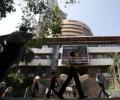
The wider NSE Nifty too ended 21.55 points, or 0.21 per cent down at 10,476.70.

Wednesday's hawkish and essentially courageous decision underscores that Governor Urjit Patel will largely represent continuity, rather than a break, with the policies and approach of his predecessor, says Richard Iley.

Many analysts argue with limited space for a fiscal stimulus, the burden of lifting growth lies squarely on monetary policy.
Rediff.com interviewed people from several walks of life to know their opinions on the rise in rates by RBI.

P K Mishra, a retired IAS officer of the Gujarat cadre, is currently serving as the principal secretary to the prime minister.

With retail inflation witnessing significant uptick in May, the Reserve Bank of India (RBI) is likely to maintain status quo in its August monetary policy review, according to a report. According to the SBI's research report- Ecowrap, inflation may remain elevated in the coming months due to several global and domestic factors. "We expect a status-quo in August. We believe RBI would still try to find a marriage of convenience of regulatory and developmental measures and monetary policy in August policy," the research report said on Wednesday.

Surplus liquidity in the banking system as measured by absorption of excess funds by the Reserve Bank of India (RBI) fell sharply at the end of the last week due to outflows on account of advance tax payments. According to the RBI data, the net liquidity absorbed by the central bank on September 16 was at Rs 3,243.57 crore, much lower than the average of Rs 56,809.92 crore in the preceding four days of the week. The average absorption of funds by the RBI so far in September is at Rs 1.13 trillion, against the average of Rs 1.2 trillion in the previous month, the data showed.

The Reserve Bank of India raised key rates on Thursday, but at the same time signalled that its monetary tightening cycle that started nearly a year ago may take a pause.

The Reserve Bank of India, for the second straight time, on Thursday kept its key policy rate unchanged at 5.15 per cent, maintaining its accommodative policy stance as long as it was necessary to revive growth. The central bank retained GDP growth at 5 per cent for 2019-20 and pegged it at 6 per cent for the next fiscal.
